
96 Food Sensitivity IgG FingerStick Test Kit with Wellness Plan
- $315
The following is a list of what is included in the item above. Click the test(s) below to view what biomarkers are measured along with an explanation of what the biomarker is measuring.
The 96 Food Sensitivity IgG FingerStick Test Kit with Wellness Plan test contains 1 test .

What Is the 96 Food Sensitivity IgG FingerStick Test Kit with Wellness Plan?
 The 96 Food Sensitivity IgG FingerStick Test with Wellness Plan provides a structured, two-part approach to exploring possible dietary triggers. This bundle includes a comprehensive IgG test that evaluates immune reactivity to 96 commonly consumed foods, paired with a wellness plan designed to help interpret and act on the results. Food sensitivities often create delayed or subtle responses, which can make them difficult to identify without guided testing. The Wellness Plan complements the test results by offering personalized recommendations, tools, and educational resources, creating a roadmap for healthier dietary choices. Together, they provide an integrated way to better understand how foods may interact with the immune system and how to use that knowledge in daily life.
| Disclaimer: IgG testing is not diagnostic of food allergies, intolerances, or disease. Results should always be interpreted with a qualified healthcare provider. |
Testing Method: Enzyme-Linked Immunosorbent Assay
Collection Method: Fingerstick Lancet 
Specimen Type: Blood Droplets 

Test Preparation: No preparation required
When and Why Someone Would Order This Test
People often turn to food sensitivity testing when they are searching for possible explanations for ongoing or unexplained health concerns. Unlike food allergies, which usually cause immediate reactions, sensitivities may contribute to delayed symptoms that surface hours or days after eating. This delay makes it challenging to identify specific triggers without structured testing. The 96 Food Sensitivity IgG FingerStick Test with Wellness Plan is particularly useful for individuals who want both accurate immune response data and guided next steps for dietary improvement.
Common situations when someone may consider this test include:
-
Persistent digestive discomfort such as bloating, gas, or irregular bowel movements.
-
Fluctuating energy levels, fatigue, or difficulty concentrating that seem food-related.
-
Recurring skin concerns like rashes, breakouts, or redness without obvious triggers.
-
Joint stiffness, inflammation, or headaches that appear inconsistently.
-
A desire for clarity in nutrition planning and a more systematic way to evaluate food triggers.
By pairing the test with a Wellness Plan, individuals not only receive insights into IgG food sensitivities but also gain structured support to put their results into practice.
What Does the Test Measure
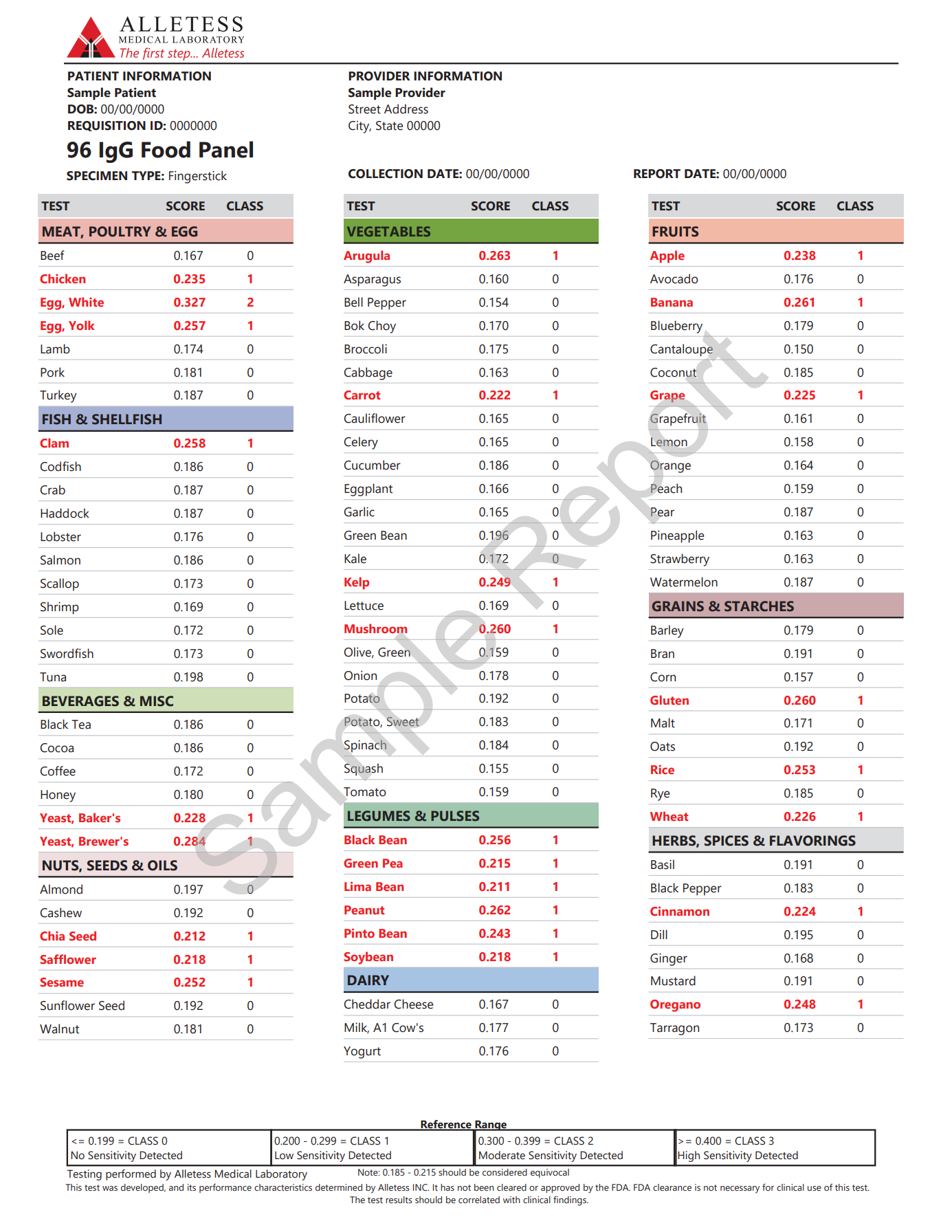
The test measures IgG antibodies, which are produced by the immune system when it recognizes and responds to specific foods. Elevated IgG responses may suggest that certain foods contribute to delayed immune reactivity.
| MEAT, POULTRY, AND EGG | VEGETABLES | FRUITS | ||||
| Beef | Arugula | Apple | ||||
| Chicken | Asparagus | Avocado | ||||
| Egg, White | Bell Pepper | Banana | ||||
| Egg, Yolk | Bok Choy | Blueberry | ||||
| Lamb | Broccoli | Cantaloupe | ||||
| Pork | Cabbage | Coconut | ||||
| Turkey | Carrot | Grape | ||||
| Cauliflower | Grapefruit | |||||
| FISH AND SHELLFISH | Celery | Lemon | ||||
| Clam | Cucumber | Orange | ||||
| Codfish | Eggplant | Peach | ||||
| Crab | Garlic | Pear | ||||
| Haddock | Green Bean | Pineapple | ||||
| Lobster | Kale | Strawberry | ||||
| Salmon | Kelp | Watermelon | ||||
| Scallop | Lettuce | |||||
| Shrimp | Mushroom | GRAINS and STARCHES | ||||
| Sole | Olive, Green |
Barley |
||||
| Swordfish | Onion | Bran | ||||
| Tuna | Potato | Corn | ||||
| Potato, Sweet | Gluten | |||||
| BEVERAGES AND MISC | Spinach | Malt | ||||
| Black Tea | Squash | Oats | ||||
| Cocoa | Tomato | Rice | ||||
| Coffee | Rye | |||||
| Honey | LEGUMES AND PULSES | Wheat | ||||
| Yeast, Baker's | Black Bean | |||||
| Yeast, Brewer's | Grean Pea | HERBS, SPICES AND FLAVORINGS | ||||
| Lima Bean | Basil | |||||
| NUTS, SEEDS AND OILS | Peanut | Black Pepper | ||||
| Almond | Pinto Bean | Cinnamon | ||||
| Cashew | Soybean | Dill | ||||
| Chia Seed | Ginger | |||||
| Safflower | DAIRY | Mustard | ||||
| Sesame | Cheddar Cheese | Oregano | ||||
| Sunflower Seed | Milk, A1 Cow's | Tarragon | ||||
| Walnut | Yogurt |
What is the Wellness Plan
The Wellness Plan is an evidence-informed resource designed to help individuals interpret their test results and apply them in a meaningful way. It offers a structured program that provides guidance on dietary adjustments, elimination and rotation strategies, and tips for maintaining a balanced and sustainable approach to nutrition. By combining educational materials, tracking tools, and practical recommendations, the Wellness Plan transforms raw test data into actionable steps.
Why pair the Wellness Plan with the test?
-
It bridges the gap between results and application, making it easier to act on findings.
-
It helps individuals approach dietary changes systematically rather than through trial and error.
-
It offers structured strategies for food substitution and nutrient balance, reducing the risk of overly restrictive diets.
-
It encourages mindful reintroduction of foods, supporting long-term success.
Together, the test and Wellness Plan provide both insights and the framework to use them effectively—creating a comprehensive path to better dietary awareness.
Food Sensitivity vs. Food Allergy vs. Food Intolerance
To fully understand the role of this test, it is important to distinguish between food sensitivity, food allergy, and food intolerance:
-
Food Sensitivity (IgG): Involves delayed immune responses mediated by IgG antibodies. Symptoms may be subtle or delayed, appearing hours or days after eating, making them hard to track without testing.
-
Food Allergy (IgE): Involves immediate immune reactions mediated by IgE antibodies. These can cause rapid and sometimes severe symptoms such as hives, swelling, or anaphylaxis. Allergy testing must be done under medical supervision.
-
Food Intolerance: Not immune-mediated. Intolerances occur when the body cannot process certain foods (for example, lactose intolerance). Symptoms are usually digestive and appear soon after ingestion.
The 96 Food Sensitivity IgG FingerStick Test with Wellness Plan focuses exclusively on IgG-mediated food sensitivities. It does not diagnose food allergies or intolerances. Its purpose is to provide insight into delayed immune responses to foods that may otherwise go unnoticed.
How Patients and Providers Use the Results
The integration of the Wellness Plan with test results enhances the utility of this bundle. The test identifies IgG antibody reactivity, while the Wellness Plan provides a roadmap for what to do with that information.
Healthcare providers may use the results to:
-
Recommend elimination or rotation diets tailored to IgG-reactive foods.
-
Compare symptoms reported by patients with immune reactivity patterns.
-
Develop structured nutrition plans that balance dietary adjustments with long-term sustainability.
Patients benefit by:
-
Using the Wellness Plan as a guide to navigate dietary changes more confidently.
-
Applying practical recommendations and food substitutions that reduce overwhelm.
-
Tracking their responses to dietary changes and refining approaches over time.
-
Establishing a healthier, more intentional relationship with food.
This dual approach transforms testing into a proactive wellness strategy rather than a stand-alone report.
Consider the 184 Food Sensitivity IgG FingerStick Test with Wellness Plan
For those seeking broader coverage, the 184 Food Sensitivity IgG FingerStick Test with Wellness Plan offers an expanded evaluation of IgG reactivity to a wider range of foods. While the 96-panel covers the most common dietary items, the 184-panel goes further by including additional grains, proteins, vegetables, fruits, legumes, and specialty items.
The larger panel is especially useful for individuals who:
-
Consume a more diverse or international diet.
-
Have not found clarity from smaller panels.
-
Wish to explore a wider scope of potential dietary triggers in one assessment.
Pairing the expanded test with a Wellness Plan provides the same structured support while offering a deeper and more comprehensive look at immune reactivity.
Conclusion
The 96 Food Sensitivity IgG FingerStick Test with Wellness Plan provides a balanced combination of scientific insight and practical application. By measuring IgG antibodies to 96 foods, the test identifies potential sensitivity patterns, while the Wellness Plan offers structured guidance to help individuals and healthcare providers apply results in daily life.
This bundle does not diagnose food allergies or intolerances, but it provides meaningful insights into how the immune system may interact with specific foods. With both testing and a guided plan, individuals can take informed steps toward dietary adjustments and improved awareness of their body’s unique responses.