
184 Food Sensitivity IgG FingerStick Test Kit with Wellness Plan
The 184 Food Sensitivity IgG FingerStick Test with Wellness Plan measures immune reactivity to 184 foods and pairs results with a structured program for dietary guidance. This bundle combines comprehensive IgG testing with personalized strategies, empowering patients and healthcare providers to apply results in daily life for more informed, evidence-based nutrition decisions.
- $519
The following is a list of what is included in the item above. Click the test(s) below to view what biomarkers are measured along with an explanation of what the biomarker is measuring.
The 184 Food Sensitivity IgG FingerStick Test Kit with Wellness Plan test contains 1 test .
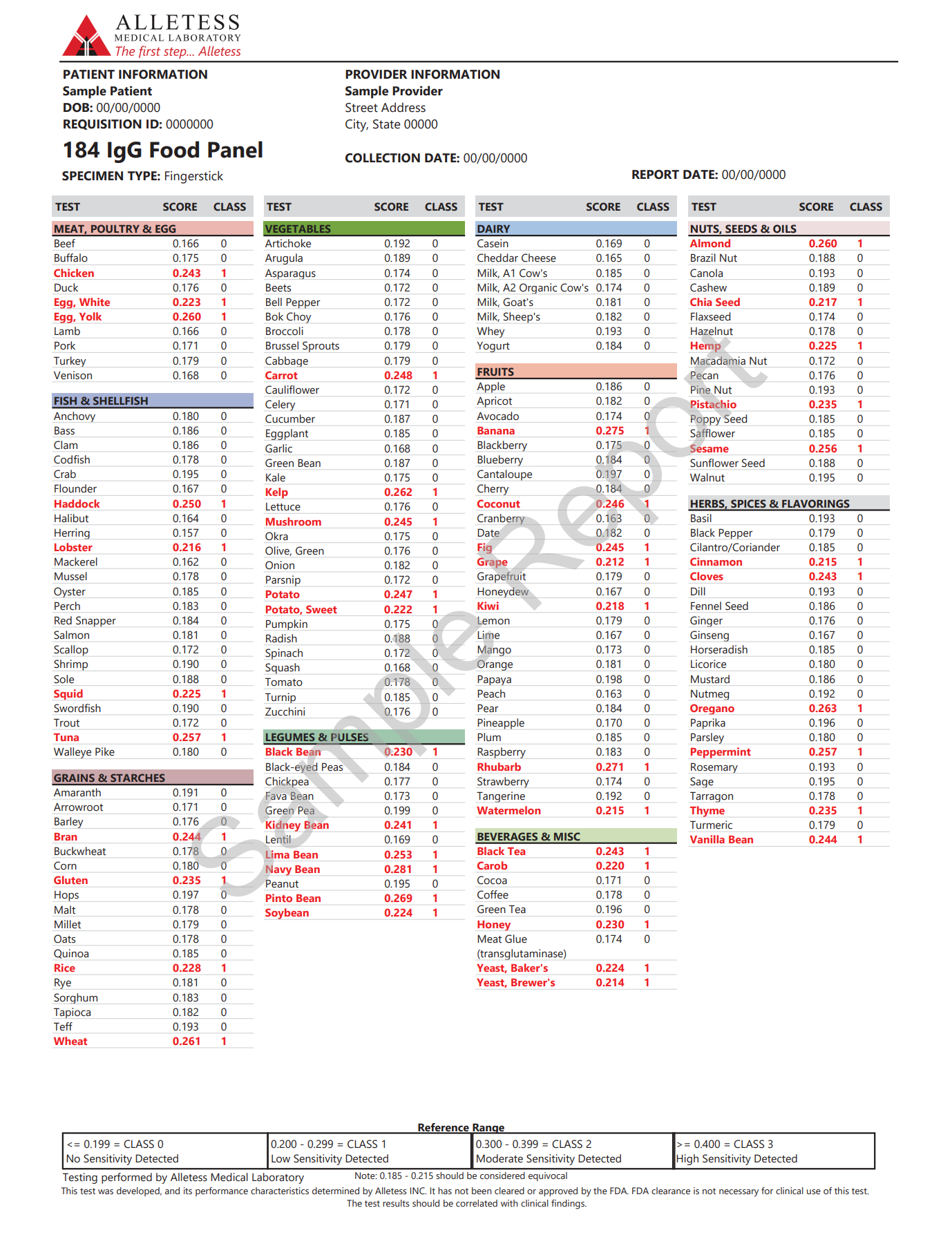

What Is the 184 Food Sensitivity IgG FingerStick Test Kit with Wellness Plan?
 The 184 Food Sensitivity IgG FingerStick Test with Wellness Plan is a comprehensive bundle that combines advanced laboratory testing with structured dietary guidance. This test evaluates IgG antibody responses to 184 foods, offering broad insights into possible delayed immune reactivity. While food allergies and intolerances are distinct conditions, food sensitivities may contribute to subtle or delayed responses that are difficult to pinpoint without structured testing. By pairing the test with the Wellness Plan, individuals not only gain detailed information about potential sensitivities but also receive a guided approach to applying the results in everyday life. This integrated solution empowers both patients and healthcare providers to make informed, sustainable dietary adjustments that align with personal wellness goals.
| Disclaimer: IgG testing is not diagnostic of food allergies, intolerances, or disease. Results should always be interpreted with a qualified healthcare provider. |
Testing Method: Enzyme-Linked Immunosorbent Assay
Collection Method: Fingerstick Lancet 
Specimen Type: Blood Droplets 

Test Preparation: No preparation required
When and Why Someone Would Order This Test
Food sensitivities can present in ways that are subtle, delayed, or easily mistaken for unrelated concerns. Because IgG responses may occur hours or even days after consuming certain foods, self-diagnosis or trial-and-error elimination diets often prove ineffective. The 184 Food Sensitivity IgG FingerStick Test with Wellness Plan helps individuals take a structured approach to understanding potential immune responses and provides the tools needed to act on those insights.
People may consider this test when they:
-
Experience ongoing digestive discomfort such as bloating, gas, or irregular bowel movements.
-
Notice skin issues like rashes, redness, or breakouts that appear inconsistently.
-
Report fluctuating energy, fatigue, or mood changes after meals.
-
Struggle with inflammation-related concerns, including joint stiffness or headaches.
-
Follow a diverse or international diet that includes foods not covered in smaller panels.
-
Seek a broader overview of immune reactivity after completing a smaller food sensitivity test.
The inclusion of the Wellness Plan ensures that results are not left to interpretation alone. Instead, individuals are supported with evidence-informed strategies to navigate changes effectively, promoting confidence and sustainability in dietary choices.
What Does the Test Measure
The 184 Food Sensitivity IgG FingerStick Test measures IgG antibodies, immune proteins that may signal delayed immune responses to specific foods. Elevated IgG reactivity suggests that certain foods may be contributing to sensitivity-type reactions.
This panel includes a broad range of foods across categories such as proteins, grains, vegetables, fruits, legumes, nuts, seeds, dairy, and spices.
| MEAT, POULTRY AND EGG | VEGETABLES | DAIRY | NUTS, SEEDS AND OILS | |||||
| Beef | Artichoke | Casein | Almond | |||||
| Buffalo | Arugula | Cheddar Cheese | Brazil Nut | |||||
| Chicken | Asparagus | Milk, A1 Cow's | Canola | |||||
| Duck | Beets | Milk, A2 Organic Cow's | Cashew | |||||
| Egg, White | Bell Pepper | Milk, Goat's | Chia Seed | |||||
| Egg, Yolk | Bok Choy | Milk, Sheep's | Flaxseed | |||||
| Lamb | Broccoli | Whey | Hazelnut | |||||
| Pork | Brussel Sprouts | Yogurt | Hemp | |||||
| Turkey | Cabbage | Macadamia Nut | ||||||
| Venison | Carrot | FRUITS | Pecan | |||||
| Cauliflower | Apple | Pine Nut | ||||||
| FISH AND SHELLFISH | Celery | Apricot | Pistachio | |||||
| Anchovy | Cucumber | Avocado | Poppy Seed | |||||
| Bass | Eggplant | Banana | Safflower | |||||
| Clam | Garlic | Blackberry | Sesame | |||||
| Codfish | Green Bean | Blueberry | Sunflower Seed | |||||
| Crab | Kale | Cantaloupe | Walnut | |||||
| Flounder | Kelp | Cherry | ||||||
| Haddock | Lettuce | Coconut | HERBS, SPICES AND FLAVORINGS | |||||
| Halibut | Mushroom | Cranberry | Basil | |||||
| Herring | Okra | Date | Black Pepper | |||||
| Lobster | Olive, Green | Fig | Cilantro/Coriander | |||||
| Mackerel | Onion | Grape | Cinnamon | |||||
| Mussel | Parsnip | Grapefruit | Cloves | |||||
| Oyster | Potato | Honeydew | Dill | |||||
| Perch | Potato, Sweet | Kiwi | Fennel Seed | |||||
| Red Snapper | Pumpkin | Lemon | Ginger | |||||
| Salmon | Radish | Lime | Ginseng | |||||
| Scallop | Spinach | Mango | Horseradish | |||||
| Shrimp | Squash | Orange | Licorice | |||||
| Sole | Tomato | Papaya | Mustard | |||||
| Squid | Turnip | Peach | Nutmeg | |||||
| Swordfish | Zucchini | Pear | Oregano | |||||
| Trout | Pineapple | Paprika | ||||||
| Tuna | LEGUMES AND PULSES | Plum | Parsley | |||||
| Walleye Pike | Black Bean | Raspberry | Peppermint | |||||
| Black-eyes Peas | Rhubarb | Rosemary | ||||||
| GRAINS AND STARCHES | Chickpea | Strawberry | Sage | |||||
| Amaranth | Fava Bean | Tangerine | Tarragon | |||||
| Arrowroot | Green Pea | Watermelon | Thyme | |||||
| Barley | Kidney Bean | Turmeric | ||||||
| Bran | Lentil | BEVERAGES AND MISC | Vanilla Bean | |||||
| Buckwheat | Lima Bean | Black Tea | ||||||
| Corn | Navy Bean | Carob | ||||||
| Gluten | Peanut | Cocoa | ||||||
| Hops | Pinto Bean | Coffee | ||||||
| Malt | Soybean | Green Tea | ||||||
| Millet | Honey | |||||||
| Oats | Meat Glue | |||||||
| Quinoa | Yeast, Baker's | |||||||
| Rice | Yeast, Brewer's | |||||||
| Rye | ||||||||
| Sorghum | ||||||||
| Tapioca | ||||||||
| Teff | ||||||||
| Wheat |
What is the Wellness Plan
The Wellness Plan is a structured program that complements test results with actionable guidance. It translates raw IgG data into practical steps, giving individuals the framework needed to adjust their diets with confidence and clarity. Instead of leaving patients to navigate results alone, the Wellness Plan provides resources that make dietary modification approachable and sustainable.
Key benefits of the Wellness Plan include:
-
Dietary Guidance: Step-by-step strategies for elimination, rotation, and gradual reintroduction of foods.
-
Food Substitutions: Suggestions for replacing reactive foods with alternatives to maintain nutrient balance.
-
Tracking Tools: Methods for monitoring how dietary changes affect symptoms or overall wellbeing.
-
Education: Clear explanations of food sensitivity principles, empowering individuals with knowledge to make informed choices.
Pairing the Wellness Plan with the 184-panel test ensures that results are not only informative but also actionable. It bridges the gap between identifying potential food sensitivities and making sustainable lifestyle changes.
Food Sensitivity vs. Food Allergy vs. Food Intolerance
Food-related conditions are often misunderstood, and it is critical to differentiate between them:
-
Food Sensitivity (IgG): This test measures IgG antibodies associated with delayed immune responses. Symptoms may appear hours or days after eating, which makes sensitivities challenging to detect without testing.
-
Food Allergy (IgE): Allergies involve IgE antibodies and can cause immediate, sometimes severe reactions such as hives, swelling, or anaphylaxis. Allergy testing is distinct and requires medical oversight.
-
Food Intolerance: Intolerances are not immune-related. Instead, they occur when the body cannot digest or process certain foods (e.g., lactose intolerance). Symptoms often appear quickly and are usually digestive.
The 184 Food Sensitivity IgG FingerStick Test with Wellness Plan focuses exclusively on IgG-mediated food sensitivities. It does not diagnose food allergies or intolerances. Its purpose is to provide structured insights into delayed immune reactivity patterns to support dietary exploration.
How Patients and Healthcare Providers Use the Results
The combination of the 184-panel test and Wellness Plan gives patients and healthcare providers a practical framework for dietary exploration. Rather than simply receiving a test report, individuals gain structured guidance to make evidence-informed choices.
Healthcare providers may use the results to:
-
Recommend elimination or rotation diets that align with test findings.
-
Compare immune reactivity patterns with reported symptoms.
-
Monitor improvements or changes in reactivity over time.
-
Help patients maintain balanced nutrition while removing or substituting foods.
Patients benefit by:
-
Using the Wellness Plan to understand and apply results step by step.
-
Making dietary changes with clarity rather than guesswork.
-
Tracking their progress to see how changes affect wellbeing.
-
Building confidence in managing their diet without unnecessary restriction.
Together, the test and Wellness Plan transform results into a guided path toward more intentional, evidence-based nutrition strategies.
Consider the 205 Food Sensitivity IgG FingerStick Test with Wellness Plan
For individuals who want the most complete coverage, the 205 Food Sensitivity IgG FingerStick Test with Wellness Plan extends the evaluation to an even larger selection of foods. While the 184-panel provides broad insights, the 205-panel includes additional specialty items, proteins, vegetables, grains, and spices for maximum coverage.
This expanded panel is particularly valuable for individuals who:
-
Consume a highly varied or international diet.
-
Want the most comprehensive exploration of possible immune reactivity.
-
Prefer to rule out as many potential food sensitivities as possible in a single test.
Pairing the larger panel with a Wellness Plan ensures that broader results are supported with the same structured guidance for practical application.
Conclusion
The 184 Food Sensitivity IgG FingerStick Test with Wellness Plan offers a comprehensive and actionable way to explore food sensitivities. By measuring IgG antibodies to 184 foods, it provides detailed insights into potential immune reactivity. The Wellness Plan complements these results with strategies, tools, and educational resources that transform data into meaningful dietary adjustments.
This test bundle does not diagnose food allergies or intolerances but instead highlights IgG-mediated responses that may contribute to delayed or subtle concerns. With its combination of broad coverage and guided support, this package equips patients and healthcare providers with the resources needed to pursue informed, structured, and sustainable dietary strategies.